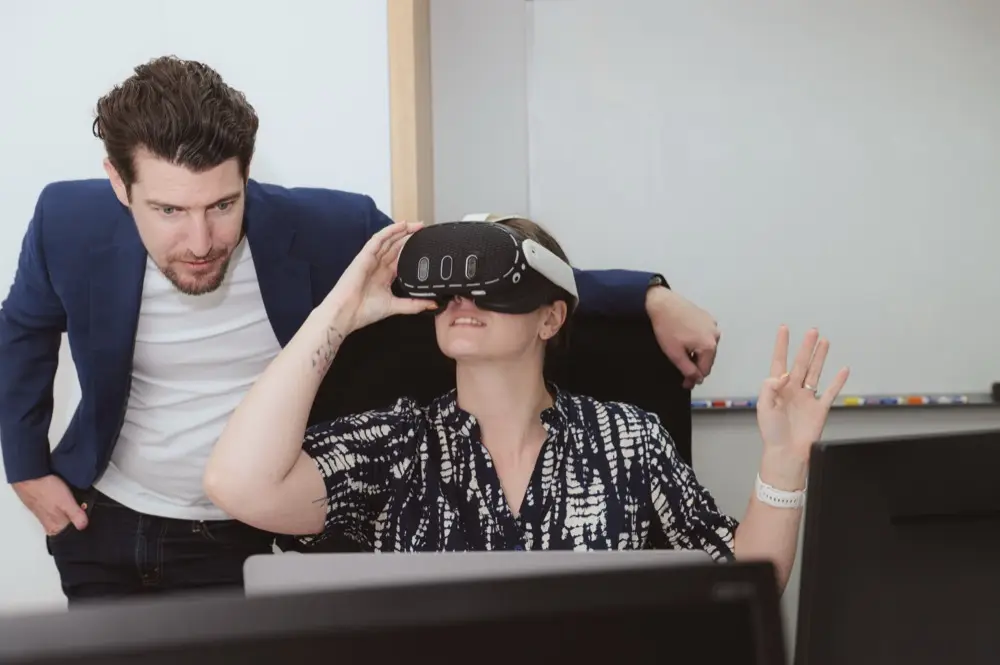
Immersive Mining
Mine Safe Global
A VR driving simulator with a physical rig, built to demonstrate a collision avoidance system at MINExpo 2024.

Featured industries
RetailWork
Our work across services and industries.
Online stores, migrations and the systems behind them.
Secure platforms, portals and integrations for financial services.
Browse insights by topic
AdvisoryInsights
Everything we've published, in one place.
Thinking on strategy, operations and AI.
Lessons from building and integrating systems.
Shopify, migrations and running a store.
VR, AR and mixed reality in practice.
 Delivered through Nexr
Augmented reality layers digital content onto what people can already see, through a phone, tablet or headset. It suits work and shopping that happen in the real world.
























What it is
People keep seeing the world around them. We add instructions, data and 3D models on top, fixed to the objects and spaces they relate to.
Select an application to see what it involves.
01 / 04
Customers place products at true scale in their own space before they buy, and see them from every angle. It builds confidence in the purchase and reduces returns.
For example
02 / 04
Step-by-step instructions shown on the real equipment, so people learn and work hands-on with guidance in front of them.
For example
03 / 04
The environment comes alive with data, graphics and interactive elements that inform and engage, from packaging to printed material and physical spaces.
For example
04 / 04
Filters and effects for social platforms that carry a brand’s message and encourage people to share their own content.
For example
AR is most useful where people are already in the real place, holding the real thing, and need more information about it.
Customers hesitate when they can’t picture a product in their own space.
How AR helps: Product visualisation shows items at true scale in the customer’s home before they buy.
Manuals are hard to follow while working on equipment.
How AR helps: Instructions appear on the equipment itself, step by step, so the work is done right first time.
Campaigns compete for attention on crowded social feeds.
How AR helps: Branded filters and effects invite people to take part and share.
Plans are hard to read on an empty site.
How AR helps: Designs and finishes are shown in place, on the site or in the room.
Complex systems are hard to explain on a page or a slide.
How AR helps: Interactive 3D models let learners explore how things work in front of them.
Visitors miss the stories behind what they are looking at.
How AR helps: Overlays add history and context to sites, exhibits and routes.
Immersive Mining
A VR driving simulator with a physical rig, built to demonstrate a collision avoidance system at MINExpo 2024.

Immersive Defence
Seven strategic sites made explorable in VR and AR on Armscor's stand at AAD 2024, delivered in 40 days.

Immersive Health and Wellness
An immersive VR platform for unconscious bias training.

Immersive Energy and Petrochemicals
A working-at-heights VR simulation that prepares teams to prevent unsafe behaviour.
A good fit when
Not always. Many AR experiences run in a web browser, so people can open them from a link or a QR code.
Most modern phones and tablets support AR. For hands-free work, we can build for AR headsets.
Often, yes. We review your files and prepare them for real-time use, or create new models where needed.
Yes. AR experiences can pull live information from the systems you already run.
Give us a sense of where people will be, what they’re looking at and what they need to know.