Realm built Nurdle to carry a piece of work through the business in one place. It reads the client’s material, supports the consultant in pricing it, produces a proposal the client signs online and sets up delivery once the client says yes.
Building the breakdown from the client’s material
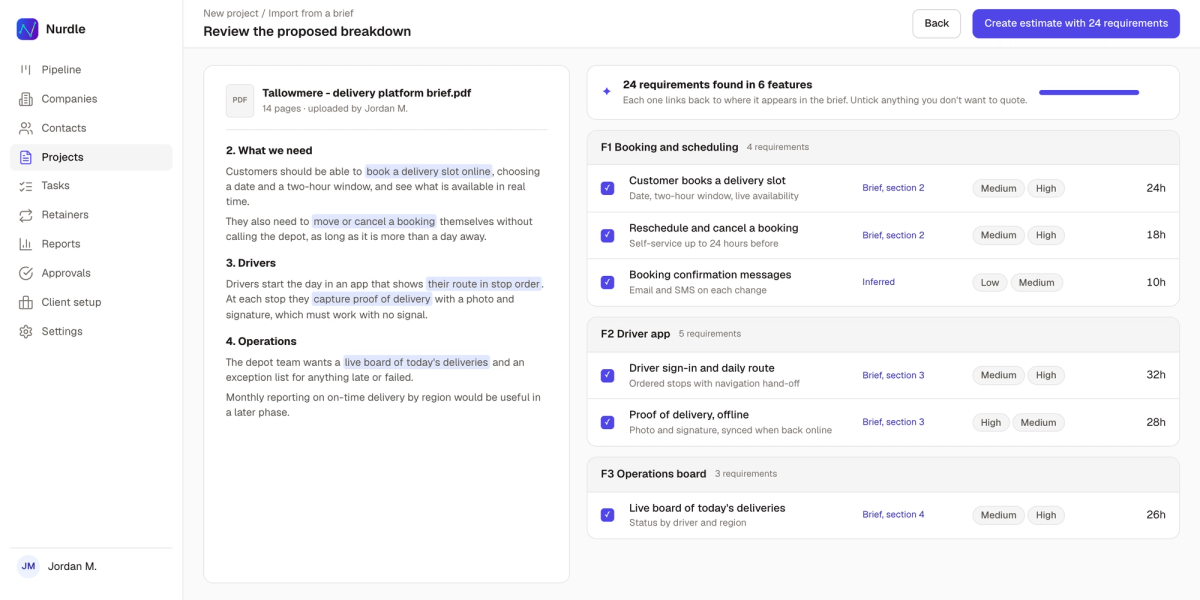
A consultant opens a new estimate from what the client has shared, such as a requirements document or a written brief, or from the transcript of a meeting with the client. Nurdle reads it and proposes a structured breakdown of every requirement, with suggested hours for each role. The hours come from a complex calculation rules engine built on Realm’s 25 years of costing projects. Because the breakdown comes from the client’s own material, a requirement on page twelve is priced as carefully as one on page one.
The consultant checks the breakdown line by line and can accept, change or replace any suggestion. They are responsible for every number in the final quote.
Estimates based on past work
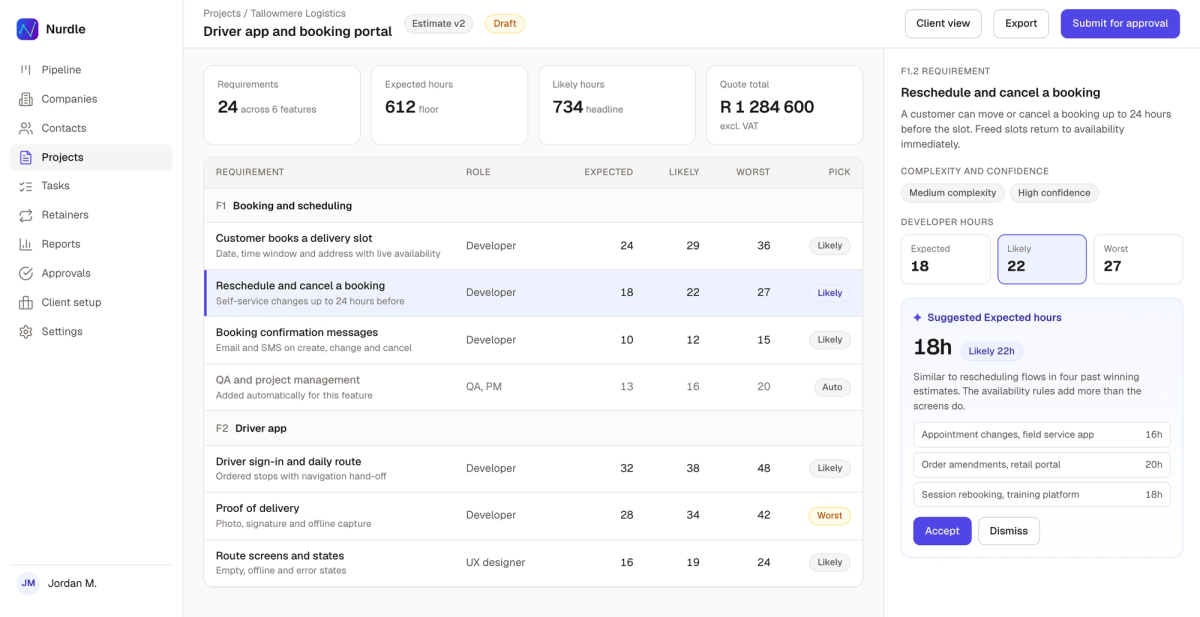
When a consultant wants a second opinion on a line, Nurdle uses retrieval-augmented generation (RAG) to find similar requirements in Realm’s past winning estimates and suggests hours with a short explanation the consultant can check. A new quote draws on the experience of the whole company.
Each estimate is a range, with an Expected, a Likely and a Worst case figure, set by how complex the work is and how well it is understood. The client can see where the uncertainty sits.
A proposal the client can read and sign
Every estimate goes through internal approval before it reaches a client. Rates are fixed at the moment a line is added, so a later change to Realm’s rate card does not alter a price the client has already seen.
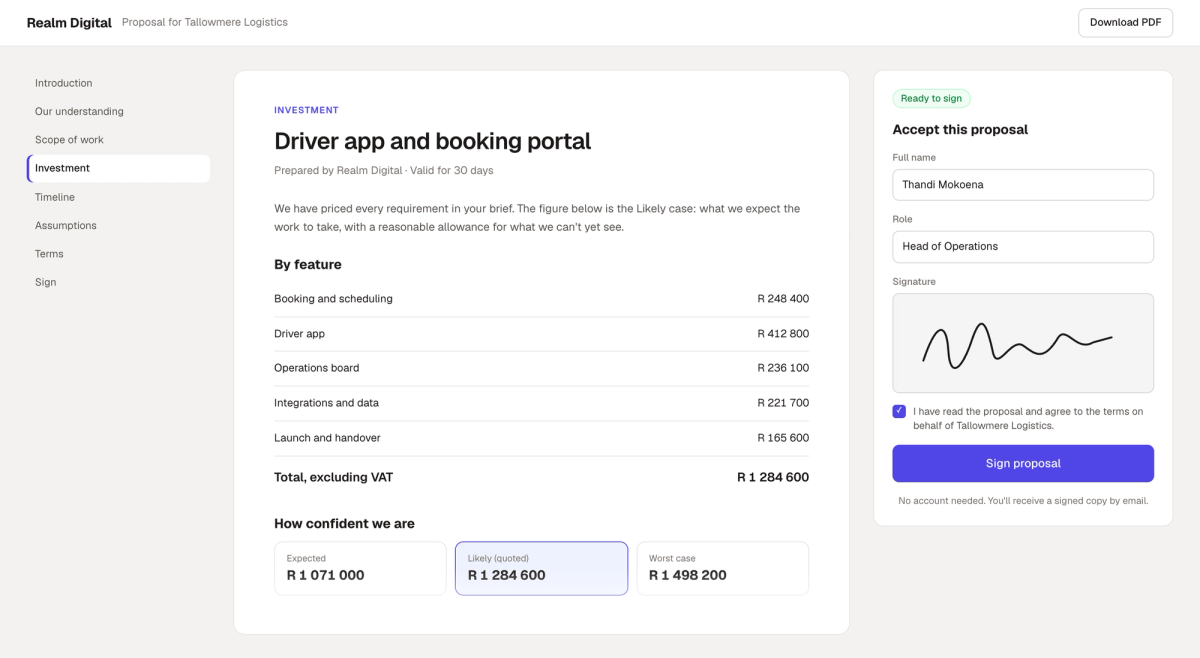
Nurdle turns the approved estimate into a branded, well laid out proposal that is easy to read. The client opens it from a private link, reads it and signs online without creating an account.
Set-up that follows the signature
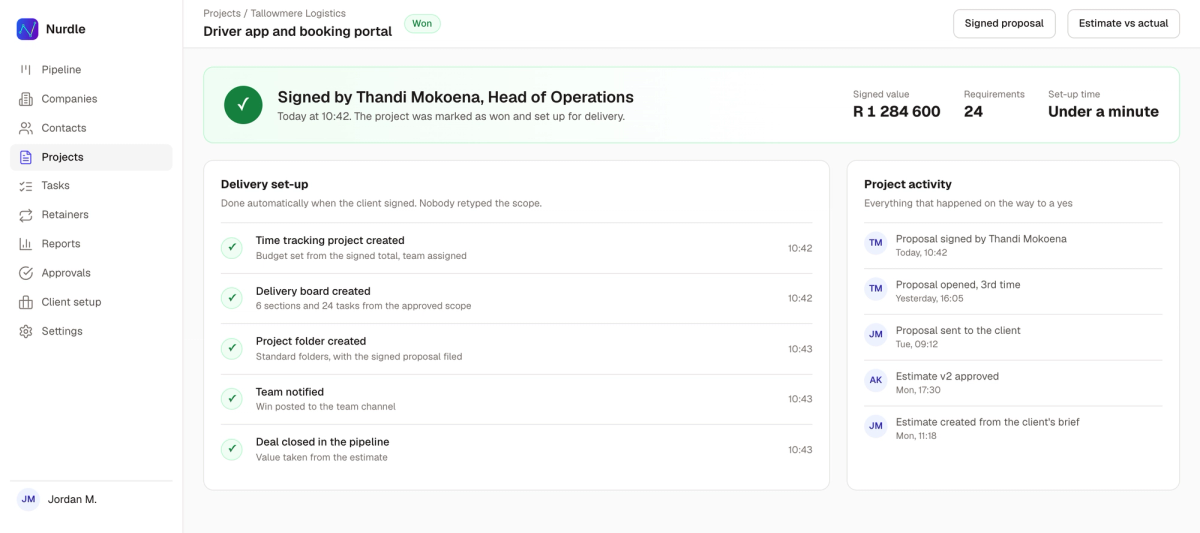
A signature marks the project as won. Set-up used to take two to three hours across separate tools. Nurdle now does the set-up itself. It adds the project and its budget to Harvest, Realm’s third-party time logging tool. It also builds the task board in Asana, Realm’s project management tool, from the approved scope, creates the shared project folder in Google Drive and lets the team know in Slack. The delivery team starts from the exact scope the client signed.
Once the project is delivered, actual hours and expenses return to Nurdle and sit beside the original estimate. The next time a client asks for similar work, the quote starts from how long that kind of work took, so every finished project makes the next quote more accurate.
The same system runs Realm’s sales pipeline. Website enquiries land in a sorting inbox, leads become deals, and a deal’s value comes straight from its estimate. A task board and a mobile version keep follow-ups moving between meetings.
Short build cycles with tests around the rules
The build used AI-assisted engineering in short cycles. The build delivered 76 features, shipped as more than 1,200 changes in six months, and each change passed the same automated tests. Those tests guard the calculation rules.
Nurdle replaced the old estimating tool early and grew while consultants used it every day. Their feedback shaped much of what came next.